Skip to Content Skip to Navigation
Join the email list!

Franz Jackson: Press

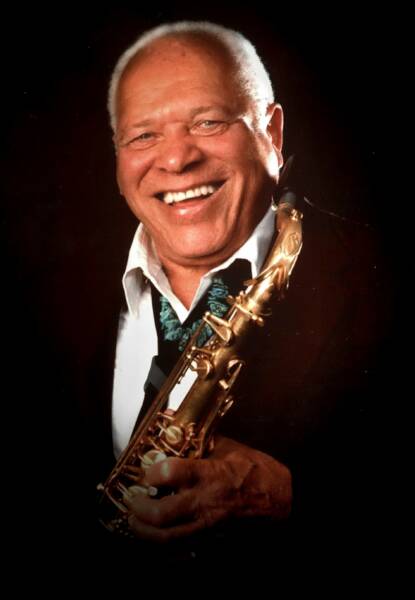
Franz Jackson 1912 ~ 2008

Legendary Chicago saxophonist Franz Jackson dies at age 95
Worked with such jazz greats as Louis Armstrong and Jelly Roll Morton
By Howard Reich | Tribune critic
May 8, 2008


Few jazz musicians in the 21st Century can claim to have known the two key inventors of the music: trumpeter Louis Armstrong and composer-pianist Jelly Roll Morton.

Franz Jackson, a legendary Chicago saxophonist who performed past his 95th birthday, worked with Armstrong, socialized with Morton and collaborated with Count Basie, Cab Calloway, Ella Fitzgerald, Fletcher Henderson and other swing-era icons.

As a virtuoso saxophonist, brilliant clarinetist and evocative vocalist, Mr. Jackson was a mainstay in Chicago jazz clubs and concert halls dating back to the Roaring '20s (except for a period in the late 1930s and '40s, when he lived in New York and Sweden).

Mr. Jackson, 95, died of natural causes early Tuesday, May 6, in Riveridge Manor, a nursing home in Niles, Mich., said his daughter, Michelle Jewell. He had suffered a hip fracture in April, she said.

Though listeners marveled at Mr. Jackson's ability to play so well for so long—he performed for more than two hours straight at a 95th birthday celebration last November—it was the particular nature of his sound that always commanded attention.

"When I think of Franz, I just think of a big, powerful saxophone," said Eric Schneider, a Chicago tenor player who frequently performed with Mr. Jackson.

"He reminded me of Coleman Hawkins," added Schneider, referring to a seminal tenor saxophonist of a more romantic era. "But he had his own thing too."

Indeed, if Mr. Jackson embraced the larger-than-life sound that was the hallmark of swing giants Hawkins and Ben Webster, he also incorporated elements of the more ethereal sounding tenorist Lester Young.

At the core of Mr. Jackson's music, though, was a deep well of soulful expression, conveyed in poetically stated melodies and touched-by-the-blues phrasings.

"He was the real thing—the authenticity of his playing" distinguished him, said Art Hoyle, a noted Chicago trumpeter who often partnered with Mr. Jackson. "He was virtually there when the music was in its infancy. When you talked to him, you were talking to history."

Mr. Jackson was born Nov. 1, 1912, in Rock Island, Ill., and came to Chicago with his mother when he was 13. He quickly began teaching himself to play reed instruments and at 16 was working with a pioneer of boogie-woogie piano, Albert Ammons. By the early 1930s, Mr. Jackson was playing for bandleader-composer Henderson—widely considered the architect of big-band swing—and learning to write scores from him.

"That was a great time to be with Fletcher, too, because he was doing a lot of [arranging] work for Benny Goodman's band at the time," Mr. Jackson said in a 1992 Tribune interview. "Basically, he was taking his great old charts and rewriting them for the Goodman band."

Mr. Jackson's education continued apace, for by performing with Armstrong, trumpeter Roy Eldridge and other innovators based in Chicago, Mr. Jackson absorbed the language of early jazz as it was being created and refined.

He moved to New York with his first wife, Maxine Johnson, in the late 1930s, but he found the jazz scene there cliquish. Even so, in Manhattan he befriended the virtually out-of-work Morton, in the waning days of the great composer's life.

By 1950, Mr. Jackson returned to Chicago, leading his Original Jass All-Stars for years at the Red Arrow club in Stickney. Although many musicians of his vintage rejected the bebop innovations that supplanted swing, Mr. Jackson absorbed them into his own, remarkably malleable work.

"A lot of guys didn't like it when bebop came along, but I liked it fine," Mr. Jackson said in the Tribune interview. "I could understand it because I knew the bebop guys like Dizzy [Gillespie] before they became famous; I played with them."

Even into his 90s, Mr. Jackson remained a strikingly charismatic figure, singing vintage tunes such as "St. James Infirmary" and "Limehouse Blues" with a vocal grit and a declamatory style rarely encountered anymore. In a marathon concert with the Chicago Jazz Ensemble three years ago in Chicago, he held his own against tenor monsters such as Johnny Griffin, Von Freeman and Ira Sullivan.

"He did exactly what he loved his entire life, he made a living at it, he raised his family on it," said his daughter. "If I have one regret, it's that he's not more widely known," she said, though Mr. Jackson's recordings—on labels such as Delmark and his own Pinnacle Recordings—are available on his Web site: franzjackson.com.

"But he was the heart of jazz."

On May 15, Mr. Jackson—who lived in Chicago and Dowagiac, Mich.—will posthumously receive the 2008 Theodore Thomas History Maker Award for Distinction in the Performing Arts from the Chicago History Museum.

In addition to his daughter, Mr. Jackson is survived by a son, Robert; five grandchildren; and a step-grandchild.

A memorial service will be held from 1 to 3 p.m. May 24 in the Apostolic Lighthouse Church in Dowagiac, Mich.

hreich@tribune.com
Franz Robert Jackson / Nov. 1, 1912-May 6, 2008


Thursday, May 8, 2008 11:18 AM EDT

Franz's life began on Nov. 1, 1912, in Rock Island, Ill., the son of Frank and Effie (Rice) Jackson.


Franz Jackson blew up a storm until age 95.

One of the last survivors of the pre-Swing era, and one of only a handful of his contemporaries still playing into the 20th century, the tenor saxophonist/clarinetist/vocalist was, quite literally, a living jazz treasure.

He left us on May 6, 2008, to join the other greats who went on before him.

Jackson was one of the last musicians to have learned Chicago jazz from its originators.

His first professional gig in his 70-plus year career was with stride pianist Albert Ammons in 1929; he was 16.

His career continued through the 1930s and '40s with such jazz luminaries as Albert Ammons, Carroll Dickerson, Jimmy Noone, Walter Barnes, Roy Eldridge, Fletcher Henderson, Benny Carter, Earl Hines, Fats Waller, Cab Calloway and James P. Johnson.


He replaced icon Ben Webster in Henderson's and Eldridge's bands and also won attention for big band compositions and arrangements for Benny Goodman, Cab Calloway and Jack Teagarden for CBS.

Between tenures in Chicago, Jackson lived in New York and Sweden, performing, composing, arranging and directing bands.

Beginning in the late '40s, Jackson embarked on tours entertaining U.S. troops abroad with his USO band.

In 1957, he formed his own successful band, the Original Jazz All-Stars, which had a 10-year stint at the Red Arrow nightclub in Stickney, Ill., a suburb of Chicago.

Jackson had become one of Chicago's most popular bandleaders and recorded seven albums during this period on his own record label, Pinnacle Recordings.

As his popularity grew. Jackson began touring the world with his band.

A hearty soloist in the Chicago tradition as well as a charismatic singer, Jackson's emphasis was always less on decorative or frivolous playing and more on the depth and sincere feeling of the music.

He continued to appear regularly at venues and festivals in Chicago and other Midwest cities well into his 90s.

Jackson held a black belt in Tae Kwan Do, which he achieved at the age of 76, and studied Oriental philosophy.

In an interview done with him in his 80s, he noted that his music was what sustained him these days: "That's how I'm existing. I'm not giving in to rock and roll and I'm keeping my standards. People like what I'm doing and nothing's really old if it's done well. I'm not satisfied with today's music because it has no melody. You need lyrics that can bring tears to your eyes and if the statement is strong, you win. I really miss big bands; now I have to do things by myself."

Jackson routinely devoted his time to providing a "living experience" education to music students at colleges and universities throughout the Midwest including Columbia College, the University of Notre Dame, Southwestern Michigan College, Bethel College and Valparaiso University.

He received numerous awards and commendations for his long-standing and ongoing contribution to the music industry.

Until very recently, he continued to travel overseas annually to perform for various events and festivals in Europe and Israel.

Jackson was honored with the Midwest Arts Jazz Grant in 1996, interviewed by Studs Terkel for Steppenwolf Theater's TRAFFIC series on improvised music in 1997, appeared on the Prairie Home Companion with Garrison Keller in 2002 and was featured on the cover of Chicago Jazz Magazine in 2004.

Franz Jackson has been credited by many as being one of the last survivors of a long-vanished era in American music and was honored in 2005 as one of the five world's greatest living jazz saxophonists by the American Heritage Jazz Series and received the Jazz Institute's Walter Dyett Lifetime Achievement Award in 2006.

He was also nominated for the 2007 National Endowment for the Arts Jazz Master Fellowship and was featured at the 2007 New Orleans Jazz and Heritage Festival. In May 2008, Franz will posthumously receive the Making History award from the Chicago History Museum honoring him as a history-making Chicagoan.

Through dozens of recordings, and the collective memories of his many fans, he will continue to keep this era alive in the spirit of all who are fortunate enough to hear him.

Franz was united in marriage to the former Virginia Lou Bradshaw on June 1, 1959, in Chicago.

His loving family includes his children Michelle (David) Jewell of Niles, and Robert Jackson of Dowagiac; grandchildren Kiri Jewell, Dustin Glaser, Corbin Glaser, Devin Glaser, T'Anna Glaser and Jade Jewell.

He is preceded in death by his wife Virginia in 2002 and two sisters.

His family will gather to celebrate his life on May 24 at 1 p.m. at the Apostolic Lighthouse Church, 30402 M-62 West, Dowagiac, MI 49047.

Memorial contributions in his name may be directed to the Jazz Institute of Chicago.

McLauchlin-Clark Funeral Home, 405 Center St., Dowagiac, MI 49047, is serving Franz's family. Please sign his guestbook and leave a memory of Franz at www.mclauchlin-clark.com.
Franz Jackson, dead at 95
by Peter Margasak on May 7th 2008 - 3:47 p.m.


Chicago has just lost perhaps its greatest living link to its earliest jazz history with the death of reedist Franz Jackson, who passed away yesterday at the age of 95.

Jackson got his start as a musician back in 1929, playing with the great barrelhouse pianist Albert Ammons, and over the decades he played with Jimmie Noone, Roy Eldridge, Fletcher Henderson, Earl Hines, Fats Waller, Benny Carter, James P. Johnson, and many others too numerous to mention. His career was nearly 80 years long, but he didn't make many records under his own name in that time--his last, I Is What I Is, was released in 2005 by Pinnacle. Still, thanks to his easy flexibility, which allowed him to bridge the gaps between traditional jazz, swing, and bebop, Jackson was a steady presence on the local scene--particularly at venues like Andy's, Dick's Last Resort, Joe's Be-Bop Cafe, the Green Mill, and Pops for Champagne--and he was reportedly in good form when playing at his 95th birthday celebration last November.

Jackson was chosen to receive the 2008 Theodore Thomas History Maker Award for Distinction in Performing Arts from the Chicago History Museum prior to his death, so his daughter Michelle Jewell will accept the award during a May 15 ceremony. A memorial service is planned for Saturday, May 24, from 1-3 PM at the Apostolic Lifehouse Church in Dowagiac, Michigan.
Living by the word.(Reflections on the lectionary)
From: The Christian Century Date: January 29, 2008 Author: Coon, Christian
Sunday, February 3

KURT VONNEGUT, the renowned writer and self-avowed humanist, once said that his epitaph should read, "The only proof he ever needed of the existence of God was music." I wonder if Vonnegut had been listening to Franz Jackson; hearing Jackson on the saxophone would inspire such a statement.

Although not everyone has heard of Jackson, he is widely known in Chicago jazz circles. I know him because for more than 35 years he and a group of musicians known as the Dixie Stompers have conducted a Mardi Gras service at my church on Transfiguration Sunday. Jackson has always been the chief draw; he's known for his gift of creating soulful music with his saxophone, especially his rendition of "What a Wonderful World."

Jackson might have been the reason Ken joined my church. Ken is a big jazz buff; when he learned about Jackson's connection to this service, he was thrilled. On Transfiguration Sunday last year, he carefully selected two of his many Jackson albums and brought them to church so Jackson could sign them. Ken arrived about 45 minutes early, sat in a front pew and clutched the albums as he waited to experience Franz Jackson live. My heart sank that day. For the first time in the history of our Mardi Gras service, Jackson didn't play. (He's 95 now, and not always able to get out.) Ken was disappointed; he'd had glimpses of glory in listening to Jackson, but he had hoped for more.
Christian Coon - The Christian Century (Jan 28, 2008)
Stars align in Dowagiac for unforgettable show


By JOHN EBY / Dowagiac Daily News
Monday, November 5, 2007 10:21 AM EST

"Happy Birthday" doesn't usually shoot electricity through an audience.


But then it isn't usually played - at least not in Dowagiac - with a New Orleans jazz flair by horn players parting the Dowagiac Middle School Performing Arts Center crowd like Saints Marching In.

Chicago jazz legend and Dowagiac resident Franz Jackson, Still Swingin' at 95, opened Sunday evening with "What a Wonderful World," then was joined by vocalist Judi K ("eight years with Franz were heaven for me"), trumpeter George Bean, trombonist Ed Bagatini, Tad Calcara, the principal clarinetist for the Utah Symphony in Salt Lake City, Hugh Leal on banjo, Jim Pickley on piano, Chris Carani on bass (his father also played with Jackson) and Hank Tausend, who played with Woody Allen's jazz band, on drums for Fats Waller's "This Joint is Jumpin'."

Master of Ceremonies Neal Tesser, Playboy's jazz critic from 1991 to 2002 and the first jazz critic for USA Today, played "traffic cop" for the constant shuffling of the "cast of characters" from 18 guest artists, such as flamboyant trumpeter Yves Francois Smierczak.

"Franz was instrumental in me playing jazz music," Smierczak told the Daily News. "One Christmas my father gave me a Roy Eldridge record. I went not only nuts over Roy, but over the tenor player. 'Who is that?' He encouraged me to play the plunger mute and growl, everything.

"We recorded a record together," said the musician who doffed his fedora to acknowledge applause or hung it from the bell of his horn.

"This is the most important thing I've done in the last three to four years of my life, maybe six or seven," said Smierczak, who has been on the Chicago jazz and blues scenes since the 1970s. He's French, but grew up in Africa.


"Certainly my favorite thing. Dowagiac probably doesn't realize that this is probably not only the oldest, but the greatest. It's a blessing that he's here and still doing it well. He's truly one of a kind, right up there with Webster, Young and Hawkins as the greatest tenor players who ever lived. I'm having a great time tonight."

Tesser offered the imagery of a slot machine jukebox. Pull the arm and it plays nothing but jackpots, with Jackson's tenor the calm eye of a sonic hurricane around which everything blew.

The opening lineup gave way to trumpeter Art Hoyle, trombonist Larry Dwyer on piano and Robert Cousins, 77, on drums for "(Take the) 'A' Train," Duke Ellington's theme song and now the official song of the New York City subway system.

So it went all night, through Jimmy Noone's "Apex Blues" and "Sweet Lorraine," "Honeysuckle Rose" sung by Crystal Ristow, "Lester Leaps In," Waller's "Jitterbug Waltz," "Exactly Like You" sung by Lisa Roti, Tishimongo Blues" (like the Elmore Leonard novel), "Perdido" (written by the Ellington musician who also penned "Caravan"), Hoagy Carmichael's "Stardust" and "Bill Bailey (Won'tcha Please Come Home)."

And that was just the first half.

After Mayor Donald Lyons presented Jackson with a key to the city, the pace picked up with "When the Saints Go Marchin' In," 1928's "I Can't Give You Anything But Love" sung by Ristow, "St. Louis Blues" (regarded as the first jazz composition for its New Orleans mixture of blues and Spanish tango), "Bourbon Street Parade," "S Wonderful," "Sweet Georgia Brown," "I'm Confessin' (That I Love You)" sung by Roti and the finale, "Chicago."

Eric Schneider, alto saxophone and clarinet, said the musicians were not flashing gang signs on stage, but trying to get New York and Chicago musicians in the same key. Holding up four fingers, or "grapes," means the number of flats - or the key of A flat.

A prodigy who started playing piano at 3, Schneider toured the world for four years with Earl "Fatha" Hines, who insisted on second billing on their album, "Eric and Earl." Schneider also toured two years with Count Basie and recorded three albums, including the Grammy Award-winning "88 Basie Street."

Schneider also played with Tony Bennett, Sammy Davis Jr., Benny Goodman, Mel Torme, Ella Fitzgerald, Sarah Vaughn and Rosemary Clooney.

"It's always a privilege and a pleasure to be able to share the stage with someone who has contributed so much to Dowagiac," Mayor Lyons said. "But Mr. Franz Jackson, still swingin' at 95, contributed way more than just making our community a better place. He has made the world a better place."

The concert, a benefit for the Jazz Institute of Chicago, Dowagiac Dogwood Fine Arts Festival, Union High School Jazz Band and Encore Dance Company, lasted 3 1/2 hours even without an anticipated closing jam session.

"My dad got to see how much he means to musicians who are here appearing today - and to all of you, and I thank you," said Jackson's daughter and manager, Michelle Jewell of Niles, who organized the event sponsored by the Dogwood and Wood Fire Italian Trattoria, where Jackson plays.

"I can't tell you how thrilled I am that this all came together as beautifully as it did," she said.

Jewell narrated a slideshow, "A Short Version of a Long Life" about his remarkable eight-decade career which began at 16 in 1929 with stride pianist Albert Ammons and continued in the 1930s and '40s with Carroll Dickerson, Jimmy Noone, Walter Barnes, Roy Eldridge, Fletcher Henderson, Benny Carter, Earl Hines, Fats Waller, Cab Calloway and James P. Johnson. Jackson replaced Ben Webster in Henderson's and Eldridge's bands and won attention for big band composing and arranging for Benny Goodman, Calloway and Jack Teagarden for CBS.

Between tenures in Chicago, Jackson lived in New York and Sweden, performing, composing, arranging and directing bands.

Beginning in the late 1940s, he embarked on tours entertaining U.S. troops abroad with his USO band.

In 1957, he formed his own band, the Original Jazz All-Stars, which enjoyed a 10-year run at the Red Arrow Nightclub in Stickney, Ill. Jackson recorded seven albums during this period on his own label, Pinnacle Recordings.

Jackson, who was 76 when he earned a black belt in Tae Kwan Do, was interviewed by Dowagiac visitor Studs Terkel in 1997.

In 2002, he appeared on the "Prairie Home Companion" with Garrison Keillor.

The man who learned Chicago jazz from its originators was featured on the cover of Chicago Jazz Magazine in 2004 and in 2005 was honored as one of the five world's greatest living jazz saxophonists by the Jazz Institute of Chicago, which awarded him the Walter Dyett Lifetime Achievement Award in 2006.

Jackson was nominated for the 2007 National Endowment for the Arts Jazz Masters Fellowship and was featured at the 2007 New Orleans Jazz and Heritage Festival.

Bagatini, the trombonist, performs with the Dynabones and operates a music store in St. Joseph with his wife, Adrienne. Besides helping set the foundations for the band departments at Lake Michigan College and Lake Michigan Catholic Schools, he also performed with Benny Goodman, Patti Page and Vic Damone.

Bean played trumpet with the big bands of Stan Kenton, Harry James and Count Basie in the 1950s and performed with Judy Garland, Frank Sinatra, Barbra Streisand, Nat "King" Cole, Tony Bennett and Mel Torme in the '60s.

Dwyer is assistant director of bands and director of jazz studies at the University of Notre Dame.

Hoyle performed with U.S. Air Force Bands from 1951-1955, appears on the "Super Fly" soundtrack and toured with Lena Horne, Tony Bennett, Johnny Mathis, Burt Bacharach, Peggy Lee and Henry Mancini, recorded with Quincy Jones, Woody Herman, Ramsey Lewis and Natalie Cole and performed with Ella Fitzgerald, Frank Sinatra, Dionne Warwick, Billy Eckstine, Dean Martin and Milton Berle.

Leal recorded a CD with Jackson at the 1998 Montreaux Detroit Jazz Festival.

Drummer Billy "Stix" Nicks, who used to sit in with Jackson at Fun Fest in downtown Dowagiac, played with Junior Walker and the All-Stars, including the hit "How Sweet It Is to be Loved by You."

Nicks has played the Apollo Theater and performed with Wilson Pickett, The Staples Singers, Louis Armstrong, Sammy Davis Jr., The Fifth Dimension, Marvin Gaye, Patti LaBelle, Gladys Knight and the Pips, The Four Tops, the Isley Brothers, The Spinners, The Temptations, Jerry Butler and Adam West and Frank Gorshen (TV's Batman and the Riddler). Nicks was also a member of Dick Clark's national Band Stand TV show.

Pianist Jim Pickley, a regular with his trio at Wood Fire, led bands for five years on cruise ships and has performed with Clark Terry, Wynton Marsalis, Bill Watrous and Ed Shaughnessy. He is music director at our Lady of the Lake Catholic Church in Edwardsburg.

Jackson played on Roti's album. She sings in English, French, Italian, Spanish and Portuguese and has performed in Europe, Asia and North, Central and South America.

Bassist Darrel Tidaback is from San Antonio, Texas, and now lives in South Bend, Ind., where he teaches at Indiana University South Bend, Saint Mary's College and Notre Dame. He has performed with Lionel Hampton, Rosemary Clooney, Bob Hope, Jerry Lewis, Carol Channing and Mitzi Gaynor.
Jazz saxophonist beboppin' up to 95
INTERMISSION

By HOWARD DUKES
Tribune Staff Writer
Franz Jackson still loves to play, and jazz musicians such as Larry Dwyer say Jackson still plays very well.
Photos provided


--------------------------------------------------------------------------------

In concert
"Still Swingin: Franz Jackson Celebrates 95" takes place at 4:30 p.m. Nov. 4 at at the Dowagiac Middle School Performing Arts Center, 57072 Riverside Drive, Dowagiac. Tickets are $50-$25. For more information, call (269) 782-1115.


When conversation turns to the life and music of Franz Jackson, it's hard to decide which number is more impressive -- his 95 years of life or his 79 years as a professional musician.

Jackson's family and about 20 musicians who have performed with the saxophonist will celebrate both during a birthday concert at 4:30 p.m. Nov. 4 at the Dowagiac Middle School Performing Arts Center.

Jackson, who turns 95 on Thursday, was 16 years old when pianist Albert Ammons hired him in 1928. The saxophonist would go on to play with such jazz greats as Cab Calloway, Duke Ellington, Lena Horne and Fats Waller.

Jackson displayed his mastery of Waller's jazz standard "Ain't Misbehavin' " during an Oct. 12 lecture for a music class at the University of Notre Dame.

Jackson played the song twice during the lecture. It was an accident, Larry Dwyer, the head of Notre Dame's jazz program, says.

Dwyer, who frequently brings Jackson in to speak to students, was playing piano and says the two men intended to play "Sweet Georgia Brown," but they got their signals crossed.

Still, hearing Jackson play "Ain't Misbehavin' " two times allowed the students to gain a deeper appreciation of the saxophonist's strengths as an improviser and a showman.

Jackson's solos on both versions were distinct, Dwyer, who first performed with Jackson in 1975, says.

"I've (always) found him delightful to play for because he knew all of these wonderful songs," he says, "and he played creatively and was an impressive improviser."

Dwyer says that Jackson was 63 when the two met after Dwyer was hired as a pianist for a combo that was the house band at a nightclub near Chicago.


Jackson poses with his saxophone in a photograph taken in the 1930s. Jackson, who will turn 95 on Thursday, is one of the few remaining jazz musicians who performed in the 1920s.

"He seemed like a musician who was totally in his prime and in control of what he played," Dwyer says.

Jackson brought all of that history with him to his talk with the Notre Dame students.

Dwyer says he tried to educate the students before they met Jackson.

"I always tell them that Jackson is a legend, and I have them listen to (musicians) like Louis Armstrong and Fats Waller," Dwyer says. "Then, I tell them that (Jackson) is one of the few musicians alive who actually played with those guys."

Still, Dwyer figures that some students might be skeptical that someone as old as Jackson would be able to play well enough to hold their interest.

Jackson, however, captured the students' interest with his stories about the people he shared the stage with, as well as his playing.

"He would play a song and (sing), and all of his vocals had little humorous (asides) that he put into his routine," Dwyer says.

Michelle Jewell, Jackson's daughter and organizer of the birthday concert, says her father enjoys talking to students.

"He has always been a strong proponent of music education," she says.

Jewell has been exposed to her father's talent, humility, joy and love for the music since she was a child.

That's one reason that Jewell loves jazz even though she grew up at a time when rock and R&B had supplanted jazz as the country's most popular music.

Jewell recalls touring with her father and meeting the musicians who performed with Jackson.

"The most enjoyable trips for me and my brother were the trips to a ski resort in Wisconsin," she says. "We would be there for two weeks, and it was a great resort with a lot of things for kids to do."

Bill Nicks, who will be one of the performers at Sunday's concert, has known Jackson for about 20 years.

Nicks is one of the people who is impressed by Jackson's musical legacy, which encompasses musical styles ranging from boogie-woogie to bebop.

The fact that so many people are willing to be a part of Jackson's birthday celebration, however, shows that Jackson also is a good person, Nicks says.

"He is also quite a gentleman," he says. "And to me, that counts as much as anything else."

Staff writer Howard Dukes

hdukes@sbtinfo.com

(574) 235-6369
Franz Jackson Day


By JOHN EBY / Dowagiac Daily News
Tuesday, October 23, 2007 10:26 AM EDT

"That's one of the reasons for this gala, is for people who don't know a lot about him to hear him and for him to get back all the joy he's given out to other people," says Franz Jackson's daughter, Michelle Jewell of Niles. "Not only does his musicality touch people, his humanity and the way he treated people was even more profound, which is an incredible gift.


"He had an opportunity to play with Louis Armstrong, but to hear my dad tell it, he didn't want to because he considered him a showman, a stage hog, if you will.

"If Louis was performing, nobody else was supposed to jump out there and try to do their thing. It was all about him. Dad wasn't like that. He much preferred playing with Roy Eldridge, who included the entire band.

"I remember meeting Dizzy Gillespie. That was the cool thing about being his daughter. I met so many famous people that, now, looking back, I was too young to appreciate, but I met Ella Fitzgerald and Dizzy Gillespie. Roy Eldridge used to come over to the apartment and hang out."

Jackson "judges a performance by audience reaction," according to Jewell. "If he has pleased the audience, he's cool. He absolutely enjoys what he's doing, but he does it to make somebody else happy. He likes to tell a story with his music and gets very annoyed listening to modern day musicians who 'just blow notes. There's no melody or flow, just who can play the most notes' the loudest, the longest and the highest. That's not jazz or what it started out to be."

Jazz "started out as party music," Jewell said. "You played it in a club while people danced and talked and had a good time. The music was a backdrop to that. Now, I think, people tend to go to a jazz club and sip a martini" as they "analyze" this "cerebral" sound.

Jackson, who "hired and fired" Miles Davis in New York, wrote a number of his own tunes.


Four compositions appear on a CD Jackson recorded with the Salty Dogs.

Jewell said in the late 1940s Jackson made his first USO tour to the Pacific.

"He ended up in Sweden, where the tour ended. He had married his first wife, who was a singer, and wanted to stop touring and spend some time with her. He played in a band in a hotel. They spent a year in Sweden, went to New York for 10 years and returned to Chicago.

"His most extensive USO shows came in the late 1960s and early '70s because I remember him being overseas and sending back movies of Vietnam. He was fascinated with people and took hours of home movie footage. I put a collection on videotape for their 30th anniversary."

Jewell said the Swedish hotel management didn't think the light-skinned Jackson was "black enough" to be a real jazz man, so pictured a darker-skinned African American on the marquee next to his wife's, even though he was playing inside. "That hurt me," Jackson confided to his family.

"He has lots of stories about the gangster era" since he was active in Chicago at the same time as Al Capone. "In fact, he was on that Geraldo special when Geraldo opened the vault. They interviewed him because he used to play at Al Capone's places," Jewell said.

"Some of the racial things he went through" were as segregated as the color line which divided the major leagues from the Negro leagues pre-Jackie Robinson.

"I played at the same time" as prominent white musicians, "but there was a white band and a black band," Jackson told his family. "The white guys did their thing, then at intermission, they'd roll the white band off and roll the black band on. We never crossed paths" except "they were in the same realm, at the same talent level," Michelle said. "I know a lot artists who prefer to live in Europe, which has been more progressive than the United States for a long time in terms of race relations."

Besides his main weapon, tenor sax, Jackson's "arsenal" included clarinet and soprano sax. For 10 years at the Red Arrow, a nighclub in Berwyn, Ill., he didn't play tenor at all, which seems unthinkable, but he focused on clarinet. He can play flute, taught himself guitar, plays piano and played first bassoon with the DePaul Symphony for 14 years "because he wanted to see what it was like to play classical music." He played command performances three years for the king of Sweden and in Israel.

Jackson's day-to-day life is "boring," his daughter said, "because he'd much rather be playing five nights a week, even though he's tired when he's done with a three-hour set at Wood Fire. He goes out to the Council on Aging. He drove until he was 92. He's still mad as hell his driver's license was taken from him. His mother lived to be 90. His sister lived into her 80s. My mom lived to be 86. Some of his health problems are directly the result of all that second-hand smoke" he breathed in clubs.

"He gave up smoking when he was a teen-ager so he could play," she said, "and he never was a drinker, except socially, with his fans. His philosophy has always been, personally and professionally, 'Everything in moderation.' Don't overdo or underdo exercise, food, wine, beer, whatever it is. Stay in the middle of the road. If it ever comes to the point where my dad cannot pick up his horn and play, he'll be gone very soon. Why stick around? That's what's been in his heart his whole life. He tears up when he hears his old Red Arrow CDs because he'll say, 'None of them are around anymore.' "
Concert honors Jazz legend


By JOHN EBY / Niles Daily Star
Wednesday, October 17, 2007 11:29 AM EDT

DOWAGIAC - Other than it will start with a video slide show encapsulating his amazing career and end with a jam session, it's hard to know what to expect in between at the gala concert planned for Sunday, Nov. 4, at the Dowagiac Middle School Performing Arts Center to commemorate the 95th birthday of Chicago jazz legend and tenor saxophonist Franz Jackson. He was born Nov. 1, 1912, in Rock Island, Ill.


"It will be fairly structured in the first half," according to his manager and daughter, Michelle Jewell of Niles. "I'm going to pair up (the 18) musicians in different groupings for specific selections. But at the end, we're going to just turn everybody loose and let them do their thing."

It will be video and audio recorded for a possible DVD or CD.

"It's going to be memorable," she said. "He saw the article in the (Oct. 1) Dowagiac Daily News before I told him because somebody at the Council on Aging gave him the paper. I was trying to keep it as quiet as possible and not let him know too far in advance because the enormity of it might make him anxious. I just want him to know how important he's been to so many people. I've learned so much since I took on the role of his business manager, and here he's my dad. I've always thought that what he did for a living was the coolest thing on earth, I've always bragged about him and it's always been fun to hear him play and be a part of that. I don't think it really sunk in the amount he's accomplished in his life and seen and done until I started researching it as a point of contact. I took it upon myself to learn about him as a musician. Even if he wasn't my dad, I would be blown away. I couldn't ask for a better gift.

"There are a lot of musicians coming from all over the country who are coming to perform in honor of my dad that also gives an opportunity to local residents to see talent they might not normally have the opportunity to see," Jewell said Friday.

"Musicians get the chance to see what this little community is like and what it has to offer. There's more to it than a concert. There's going to be a great collection of talent in one spot that might never happen again. It certainly won't happen again in Dowagiac, unless he lives to be 100."

Plus, the gala benefits the Union High School Jazz Band, Encore Dance Company, the Jazz Institute of Chicago, which Jackson helped found, and and Dogwood Fine Arts Festival.


The event is sponsored by Dogwood and Wood Fire Italian Trattoria. Tickets range from $25 to $50 and may be purchased online at www.dogwoodfinearts.org or by calling (269) 782-1115.

"We think it's important that people of all ages come out and see this," Jewell said. "As Larry (Seurynck of Wood Fire) points out, it's a great opportunity for people who know little or nothing about jazz or who have preconceived notions about jazz. Hear the real thing played by guys who helped make history. It may change some opinions, enlighten people and get some converts."

Jackson "probably wouldn't be here today if he didn't have the stamina and strength from blowing his horn all those years," she said. "It's incredible to me every time I watch him perform. I can be battling with him in the car about taking his medicine, but when he puts that horn in his mouth, he turns back the clock 40 years. My husband shakes his head at the way he puts the horn in his mouth, closes his eyes and he's gone to a completely different place."

Jewell, who has a younger brother, "loves music" and played clarinet, bass clarinet and bassoon in school band, "but it was hard to try to live up to his reputation. My passion was for dance. My mom (Virginia) didn't work. She was a stay-at-home mom. If we had a break at school, we had a motor home and we'd pack up the family and the dog. We went up to Wisconsin almost every Christmas because he played at a ski lodge up there for a festival. It was great for us as kids, getting to see different parts of the country, while he was working and doing what he loved. My brother is two years younger and never played anything. He has a son who played saxophone for a while in school. He's still musically inclined and is in a garage band."

Jewell doesn't ever remember being left with a babysitter growing up.

"Never," she said. "If he was playing, she'd take us and he'd fight with the owners because little kids are not supposed to be in a bar. I distinctly remember one argument: 'That's my family, and they're staying right here or I'm not playing.' And we stayed."

Michelle said Franz was about 12 when he heard a man blowing tenor sax in his building and said, "Mom, I want one of those." Jackson's mother and step-father (his dad died before he was 3) bought him an alto sax. "He had a couple of lessons from a musician at the Savoy, where he went down every week to listen to the pit band playing for movies." Then his parents split up and he had to get a job to help out his family, ending his lessons.

"It was almost kismet," Jewell said. "He kind of instinctively knew he had the basics and it was his job to expand on that and figure out where to go from there. He started playing with records."

Jackson grew up in Chicago. How did he happen to end up in Dowagiac?

"The silver round house on M-51 South is my grandmother's house," Jewell said. The Jackson family still owns the rental property.

"He had been commuting from Chicago to Dowagiac," Jewell said, "for probably 20 years before we actually moved here as a family. Eventually, they owned the land across the street and decided to build a house to sell, but they gave it to Franz and Virginia. Schools were better here and it was a more peaceful environment than Chicago, where we were basically right on the Dan Ryan. It was not the best place to raise a couple of kids. It was going downhill even when I was little. We kept the apartment building in Chicago for a long time, so he lived there and managed it. He decided to sell that after his mother died and moved in with his sister, who had a house in Chicago," so Jackson could continue to commute between playing in Chicago and being with his family in Dowagiac.

For a 94-year-old man, Jackson keeps a surprisingly rigorous schedule, including his monthly gig at Wood Fire, periodic lectures at the University of Notre Dame - including one Oct. 12 - and performances back-to-back weekends in Chicago in late September for Albert Ammons' centennial.

The pianist who pioneered boogie-woogie gave Jackson his first job when he was about 16.

"I'm most frustrated with the lack of recognition," she said. "People don't know about all that he's accomplished and the contribution he's made to jazz history. I was very disappointed that he didn't get the NEA (National Endowment for the Arts) Jazz Masters grant. I thought he was a shoo-in for that when he got the nomination. How much longer is he going to be here? I want people to know about him while he's still here, and can take advantage of his talent and expertise, because when he's gone, that's gone, too, except on recordings" he started making in 1931.

"That's one of the reasons for this gala, is for people who don't a lot about him to hear him and for him to get back all the joy that he's given out to other people. Not only does his musicality touch people, his humanity and the way he treated people was even more profound, which is an incredible gift. He had an opportunity to play with Louis Armstrong, but to hear my dad tell it, he didn't want to because he considered him a showman, a stage hog, if you will. If Louis was performing, nobody else was supposed to jump out there and try to do their thing. It was all about him. Dad wasn't like that. He much preferred playing with Roy Eldridge, who included the entire band. I remember meeting Dizzy Gillespie. That was the cool thing about being his daughter. I met so many famous people that, now, looking back, I was too young to appreciate it, but I met Ella Fitzgerald and Dizzy Gillespie. Roy Eldridge used to come over to the apartment and hang out."

Jackson "judges a performance by audience reaction," according to Jewell. "If he has pleased the audience, he's cool. He absolutely enjoys what he's doing, but he does it to make somebody else happy. He likes to tell a story with his music and gets very annoyed listening to modern day musicians who 'just blow notes. There's no melody or flow, just who can play the most notes' the loudest, the longest and the highest. That's not jazz or what it started out to be."

Jazz "started out as party music," Jewell said. "You played it in a club while people danced and talked and had a good time. The music was a backdrop to that. Now, I think, people tend to go to a jazz club and sip a martini" as they "analyze" this "cerebral" sound.

Jackson, who "hired and fired" Miles Davis in New York, wrote a number of his own tunes. Four compositions appear on a CD Jackson recorded with the Salty Dogs.

Jewell said in the late 1940s Jackson made his first USO tour to the Pacific. "He ended up in Sweden, where the tour ended. He had married his first wife, who was a singer, and wanted to stop touring and spend some time with her. He played in a band in a hotel. They spent a year in Sweden, went to New York for 10 years and returned to Chicago. His most extensive USO shows came in the late 1960s and early '70s because I remember him being overseas and sending back movies of Vietnam. He was fascinated with people and took hours of home movie footage. I put a collection on videotape for their 30th anniversary."

Jewell said the Swedish hotel management didn't think the light-skinned Jackson was "black enough" to be a real jazz man, so pictured a darker-skinned African American on the marquee next to his wife's, even though he was playing inside. "That hurt me," Jackson confided to his family.

"He has lots of stories about the gangster era" since he was active in Chicago at the same time as Al Capone. "In fact, he was on that Geraldo special when Geraldo opened the vault. They interviewed him because he used to play at Al Capone's places," Jewell said.

"Some of the racial things he went through" were as segregated as the color line which divided the major leagues from the Negro leagues pre-Jackie Robinson.

"I played at the same time" as prominent white musicians, "but there was a white band and a black band," Jackson told his family. "The white guys did their thing, then at intermission, they'd roll the white band off and roll the black band on. We never crossed paths" except "they were in the same realm, at the same talent level," Michelle said. "I know a lot artists who prefer to live in Europe, which has been more progressive than the United States for a long time in terms of race relations."

Besides his main weapon, tenor sax, Jackson's "arsenal" included clarinet and soprano sax. For 10 years at the Red Arrow, a nightclub in Berwyn, Ill., he didn't play tenor at all, which seems unthinkable, but he focused on clarinet. He can play flute, taught himself guitar, plays piano and played first bassoon with the DePaul Symphony for 14 years "because he wanted to see what it was like to play classical music." He played command performances three years for the king of Sweden and in Israel.

Jackson's day-to-day life is "boring," his daughter said, "because he'd much rather be playing five nights a week, even though he's tired when he's done with a three-hour set at Wood Fire. He goes out to the Council on Aging. He drove until he was 92. His mother lived to be 90. His sister lived into her 80s. My mom lived to be 86. Some of his health problems are directly the result of all that second-hand smoke" he breathed in clubs.

"He gave up smoking when he was a teenager so he could play," she said, "and he never was a drinker, except socially, with his fans. His philosophy has always been, personally and professionally, 'Everything in moderation.' Don't overdo or underdo exercise, food, wine, beer, whatever it is. Stay in the middle of the road. If it ever comes to the point where my dad cannot pick up his horn and play, he'll be gone very soon. Why stick around? That's what's been in his heart his whole life. He tears up when he hears his old Red Arrow CDs because he'll say, 'None of them are around anymore.' "
Still swingin': Jackson turning 95


Monday, October 1, 2007 10:20 AM EDT

A gala celebration concert is planned for Sunday, Nov. 4, in Dowagiac to commemorate the 95th birthday of Chicago jazz legend, tenor-saxophonist Franz Jackson.


Musicians from across the country will come together to pay musical tribute to Jackson, who will reach a milestone most people never see, yet who continues to delight and inspire his audiences every time he picks up his horn.

Born Nov. 1, 1912, in Rock Island, Ill., and raised in Chicago, the essentially self-taught Jackson started his professional career at the age of 16 with boogie-woogie pianist Albert Ammons.

He has played with virtually every renowned jazz great, including Count Basie, Cab Calloway, Duke Ellington, Fats Waller, Fletcher Henderson, Jimmy Noone, Earl Hines, Ella Fitzgerald and Lena Horne.

He formed his own band, The Original Jazz All-Stars, in 1957 and solidified himself as a Chicago jazz institution with various appearances at clubs throughout the city, most notably a 10-year engagement at The Red Arrow nightclub in Berwyn, Ill., as well as three-year stints at the Jazz Ltd. and Old Town Gate.

Since then, he's played at virtually every jazz haunt in Chicago, including Andy's, Dick's Last Resort, Joe's Be-Bop Caf/, The Green Mill, Fitzgerald's and Pops for Champagne.

Jackson has performed throughout the world, including entertaining U.S. troops overseas in the 1950s and '60s.


He has been a repeat guest performer for royalty in Sweden and Israel and was a 2005 American Heritage Jazz Series Honoree as one of the Greatest Living Jazz Tenor Saxophonists.

He has appeared on "The Prairie Home Companion" with Garrison Keillor and been interviewed by Dowagiac visitor Studs Terkel for Steppenwolf Theater's TRAFFIC series on improvised music.

In 2006, he received a nomination for the National Endowment for the Arts Jazz Masters Fellowship and was the recipient of the Jazz Institute of Chicago Walter Dyett Lifetime Achievement Award.

Jackson continues his career to this day, most recently appearing in Chicago for the "Albert Ammons Centennial Celebration" in September and the New Orleans Jazz Festival this past May.

He continues to perform in Chicago and the southwestern Lower Michigan/northern Indiana area, including periodic lectures on jazz history at the University of Notre Dame.

According to Scott Yanow, jazz historian, Jackson is among the remaining 14 living musicians and singers who recorded before 1940, many of whom are now retired from performing, and he "goes back as far as anyone," having first recorded in 1931.

Some of the musicians slated to perform include Chicago saxophonist Eric Schneider; trumpeters Art Hoyle, George Bean and Yves Francois; drummers Bob Cousins, Billy Nicks and Hank Tausend; pianists Larry Dwyer and Jim Pickley; bassists, Darrel Tidaback, Thomas Palmer and Chris Carani; vocalists Lisa Roti and Judi K., and Mwata Bowden and members of the AACM Jazz Ensemble.

In addition to honoring Jackson, this concert will benefit four organizations committed to maintaining excellence in and promotion of the arts in the Midwest: the Jazz Institute of Chicago (of which Jackson is a founding member), the Dowagiac High School Jazz Band, the Dogwood Fine Arts Festival and Encore Dance Company.

Held in the Dowagiac Middle School Performing Arts Center, the concert is sponsored by the Dogwood Fine Arts Festival and Wood Fire Italian Trattoria.

Tickets sales begin today, Oct. 1.

Tickets range from $25 to $50 and may be purchased online at www.dogwoodfinearts.org or by calling (269) 782-1115.

There are also a limited number of tickets available for a private buffet reception with Jackson following the concert.

Please visit www.franzjackson.com or www.dogwoodfinearts.org for more information.
Sticking to their roots

From: Jerusalem Post
Date: October 11, 2002
Author: Barry Davis


Jerusalem Post

10-11-2002

Headline: Sticking to their roots
Byline: Barry Davis
Edition; Magazine
Section: Arts
Page: 20

Friday, October 11, 2002 -- Next Friday's appearance of 89-year-old Chicago-based reedman Franz Jackson at the Tel Aviv Museum will be something of a landmark occasion for our own small jazz community. It is not every day we play host to a musician who remembers entertaining young Charleston-dancing blacks on weekend Chicago-New Orleans round-trip train excursions back in the 1920s.

Over the years, jazz has not exactly gained a reputation for being the healthiest profession. Although the lifestyle of the average jazzman has changed significantly for the better in the past two or three decades, the specters of prematurely departed musicians, such as Charlie Parker - who died at the age of just 34 - and Billie Holiday, who made it to 44, still cast a pall of self-destructiveness over the jazz sector.

Then again, there have been some notable examples of longevity within the fraternity. Almost a nonagenarian (he turns 90 next month), Jackson obviously has a handle on staying the course. Ninety-five-year-old, still highly active fellow reedman Benny Carter is about the only other pre-swing era jazz musician still around, following the recent death of 93-year-old vibraphonist-drummer Lionel Hampton.

In an arts field rife with anecdotes and rich folklore, one of the most delightful stories is the one told about pianist Eubie Blake, who is quoted as exclaiming on his 100th birthday, in 1983: "If I'd known I was going to live this long I would've taken better care of myself." He died just five days later.

But, clearly, Jackson was not asked here as the opener of this year's Israeli Opera jazz series solely because of his advanced years. Over the past 70-plus years he has built up and maintained a reputation for energetic traditional/swing jazz, as well as an ability to go with the musical fashion flow.

"The style of music is not something I think about," said Jackson in a telephone interview from his Chicago apartment. "People ask for what they want and I play it."

Taken at face value, such a statement seems to suggest something of a sycophantic approach to his art. Nothing could be further from the truth. There may be a thin line between ensuring your audience is well entertained, and maintaining the highest standards of your chosen art form, but Jackson has managed that conundrum with ease for a long time.

"Louis Armstrong gives a pretty good idea of what was happening back then," he says. "He used to tell stories at his concerts. I used to catch his shows when he came to Chicago. A lot of people used to copy his style. I heard something I liked, listened to it, and memorized it."

THAT WORK ethic tells you a lot about Jackson. Despite starting out when jazz playing was a far less complex discipline - this was in the days before Charlie Parker, Dizzy Gillespie and Thelonious Monk developed the highly energetic, and sometimes frenetic, bebop style - Jackson has always been receptive to his colleagues' work, and incorporated other styles in his own playing.

"I liked guys like [pre-bebop but rhythmically complex saxophone legend Coleman] Hawkins. I took the principle of it, and extended it to the best of my abilities."

Most music lovers regard pre-bebop styles, such as ragtime, swing and trad jazz, as much simpler forms of improvised music. As far as Jackson is concerned (with apologies to Gertrude Stein) music is music is music, period.

"All these styles are just a matter of playing music that somebody asks for. People mark a style by the way certain people play. If I like what they're doing, I play it that way too."

That simplistic interpretation of jazz, surely, must stop short of the avant-garde or free jazz style played by the likes of pianist Cecil Taylor or saxophonists John Coltrane and Albert Ayler in the 1960s. Coltrane and Co. won kudos for their frontier-pushing artistic endeavor but, at that time, increasing numbers of music fans began to drift away from jazz in favor of eminently more palatable pop and rock material.

Simply put, Jackson is not a big fan of avant-garde jazz. "People have always wanted to hear songs," says Jackson. "When John Coltrane played 'My Favorite Things' [from The Sound of Music] it didn't sound good. I listen to what's going on now [in jazz], and I think some of the things they play are unnecessary - they don't say anything. It's just a bunch of notes. I've heard some stuff recently that I wouldn't ordinarily listen to - I've had a backache and I've been staying in one place for a while, listening to music. They take one theme and then they make something on top of that, and they keep that going through the whole tune. To me, that's monotonous."

Then again, as Jackson points out, you can play around with a number as much as you want. That is, after all, the whole principle of improvised music.

"You can take a tune and play it according to any style. Take [George and Ira Gershwin's] 'I Got Rhythm' for instance. You take a certain set of chords and you can make different tunes of that set. You can play it as a bop number, or a dance number, or anything you want. You make figurations that fit the tempo. That's more or less what swing was."

As far as Jackson is concerned, if art isn't user friendly it simply isn't going to catch on. He believes it isn't just a matter of a new art style, by definition, being different from anything the consumer has previously encountered. Bebop was very different - and more cerebrally challenging - from the swing and traditional jazz that preceded it. But it was, of course, eventually embraced by the mainstream.

"Most people didn't know what to make of bebop when it first came out because they couldn't hum it," Jackson declares. "I don't care what you're playing, how are people going to get that style in their mind if they can't hum it? That's all music is. That's what I don't like about some of the modern players. In order to make certain kinds of notes or noises, they're just not being artistic. The music is supposed to sound good and to make people feel good."

JACKSON HAS been making his listeners feel good ever since he secured his first professional jazz engagement in the Chicago area in 1926. It was an unsalaried, tips-only job playing dance music with a band on a boat that ran from Jackson Park to Navy Pier and back about half a dozen times a day. The first fixed-pay position he had was with famous boogie-woogie pianist-bandleader Albert Ammons. It was that job that encouraged Jackson to further his musical education. He was frustrated by the fact that his fellow players could not read music. Hence, whenever someone left the band it took a while until the new man learned the pieces by heart and the orchestra could resume normal service.

The young saxophonist then enrolled at Chicago Musical College and spent two years learning how to write music. He got his first opportunity to put his new skill into practice when he joined Casa Simpson's band, which was booked to play at a Mafia-controlled speakeasy in Chicago's Loop area. Jackson recalls getting paid on a nightly basis, "because the next day the place might be burned down by a rival group of gangsters or padlocked by revenue agents." Those were the days.

Jackson remained gainfully employed throughout the 1930s, doing stints with some of the top bandleaders of the day, including Jimmie Noone, Roy Eldridge and Fletcher Henderson. He traveled to New York with the latter and later made it to the West Coast with the Earl Hines Orchestra. He traveled extensively throughout North America until the mid-1950s before returning to Chicago where he formed his Original Jazz All Stars, which enjoyed a 20-year run of success.

Jackson now limits most of his live work to the Chicago area and records with his own Pinnacle label, his latest release being the 1997 CD I is what I is. The album contains 15 tracks of deliciously performed traditional jazz, with Jackson backed by trumpeter George Bean, pianist Joe Johnson, bassist Truck Parham and drummer Jim Herndon. This is not some post-modern band of youngsters on a retro trip but a collection of improvised roots music simply and succinctly delivered by musicians who know exactly where jazz comes from. Needless to say, you can hum all the tunes with ease.

Keywords:

Copyright 2002 Jerusalem Post. All Rights Reserved
Barry Davis - The Jerusalem Post (Oct 11, 2002)
Living Legend


Jerusalem Post

09-20-2002

Headline: Living Legend
Byline: Barry Davis
Edition; International
Section: Arts
Page: 29

Friday, September 20, 2002 -- These days the epithet "legend" is attached to almost any artist who has been around for a few years and has achieved a high degree of media exposure. But, veteran jazzman Franz Jackson is, truly, a living legend.

The saxophonist-clarinetist, who will open the new Israeli Opera jazz series on October 18 (at 10 p.m.), will be 90 years old this November. He is one of the last survivors of the pre-swing era. He gave his first public performances in Chicago in 1926, as part of a dance music band which played on a boat that plied a regular route around the city on Lake Michigan.

He soon graduated to more stellar outfits led by the likes of pianist Albert Ammons, clarinetist Jimmie Noone and trumpeter Roy Eldridge and by the late thirties landed a regular job with the highly acclaimed Fletcher Henderson Orchestra. Up to this time, most of his work had been in the Chicago area but he moved to New York in 1938 and rejoined Eldridge's band.

Over the next decade he traveled extensively around the United States,playing with Earl Hinesâ orchestra in California between 1940-41 before teaming up with pianist Fats Waller and later with the Cootie Williams big band. In the late forties he went abroad on a number of USO tours before returning to Chicago in 1950 which still serves as his base.

Despite the advent of swing, bebop and later more modern jazz genres which embraced commercial forms of music Jackson remains faithful to the earliest traditional jazz styles. It will be a rare treat to see and hear him perform in Tel Aviv.

For further information call: 03-6208430 or 03- 6927805

Keywords:

Copyright 2002 Jerusalem Post. All Rights Reserved
Barry Davis - The Jerusalem Post (Sep 20, 2002)
CONCERT REVIEW: Chicago Jazz Ensemble gets better with age

University Wire

04-04-2005

(The Columbia Chronicle) (U-WIRE) CHICAGO -- In the jazz world, age ain't nothin' but a number. On March 19, several of Chicago's oldest and most influential tenor sax players proved that by blowing up a storm with the Chicago Jazz Ensemble in the Great Chicago Tenor Saxes at the Art Institute's Rubloff Auditorium, 230 S. Columbus Drive.

Under the direction of trumpeter Jon Faddis, the CJE, Columbia's resident jazz ensemble, put on a two-and-a-half-hour show demonstrating the orchestra's versatility and offering a sample of jazz history from the 1920s to the 1960s.

The ensemble couldn't have found better guest soloists to pay homage to jazz's evolution than tenor saxmen Johnny Griffin, Ira Sullivan, Von Freeman, Franz Jackson and Eric Alexander. While their combined age is about 360, the guest performers demonstrated that jazz is like a fine wine that only gets better with age.

At almost 93, Franz Jackson was the eldest member of the group and by far the most captivating player. Hobbling across the stage, Jackson appeared vulnerable. But once he took his seat and softly sputtered the smokey opening notes of the standard late-night ballad, "Body and Soul," it was obvious he was in top form.

The living legend, who began his career playing with the likes of pianist Fats Waller and trumpeter Roy Eldridge, played like any note could have been his last. His simple blues riffs sounded like the warm scratchy sounds of an old 78 rpm record and were a reminder that sometimes less is more. On the up-tempo Louis Armstrong classic "Struttin' With Some Barbecue," Jackson's singing evoked Satchmo's husky chant and a smile never left his face.

Griffin also put on quite a show, playing in a more relaxed style than in his early days. He made his first appearance of the night by shuffling onto the stage to share the spotlight with CJE vocalist Bobbi Wilsyn. For his solo, he performed his own "When We Were One," a down-tempo number that showed restraint in his playing.

Typically known for his lightning-fast runs, Griffin played in a more lyrical soul-jazz mode that emphasized his legato phrasing. Though his tone was somewhat muted, the orchestra was able to support the song's sweeping arrangement, and Griffin had a few opportunities to show off his chops.

The three other saxmen played with fire. On saxophonist Sonny Sitt's "The Eternal Triangle," Alexander, the youngest of the bunch at 36, paid his debt to the great saxophonists from Charlie Parker to John Coltrane, blowing through the tune's chord changes with speed and precision.

Sullivan took on one of the more adventurous tunes of the evening, pianist Horace Silver's mid-tempo classic, "Nica's Dream," and Freeman turned out a moving rendition of "Stella by Starlight."

The show was capped off by a full-band performance of the Count Basie staple "Jumpin' at the Woodside" taken at nearly double its standard tempo, during which the guest tenormen had ample time to flaunt their improvisational skills. Each played an extended solo before all trading eights and fours on the chorus.

Even though, technically, the soloists were playing the same song, their collective ideas bled into one another, creating dissonance that was simply captivating. It was a sound that combined 80 years of jazz experience and reminded the audience that while styles have changed in time, the art of improvisation always comes from the heart.

In the first half of the program, the CJE also performed several numbers without the guests, which served to emphasize the band's versatility. Tenor sax player Pat Mallinger did a fine job of avoiding John Coltrane's style during his solo on "The John Coltrane Suite," a three part piece that alternated between bright swing and mid-tempo blues. And tenor sax player, Rob Denty, played an understated solo that ended the first half of the show on a high note.

But nothing could have taken the glory away from Griffin, Sullivan, Freeman, Jackson and Alexander. Their masterful playing was a testament to the vitality of jazz a century after its creation.
Jeff Danna - University Wire (Apr 5, 2005)
From: Chicago Sun-Times Date: September 2, 2003 Author: Kevin Whitehead

Chicago Jazz Festival
AT Grant Park

'Struttin' With Some Barbecue," Franz Jackson sang, but no fires burned in Grant Park on Sunday. "It Might As Well Be Spring," Karrin Allyson chimed in. Spring in the tropics.

The open-air Chicago Jazz Festival is usually lucky, weather- wise, but on the last day of the 25th edition luck ran out. Rain and more rain kept attendance light and diehard fans soggy. Still, jazz musicians know about performing under difficult conditions. They got on with it.

In the 1930s, Franz Jackson played tenor saxophone well enough to replace Ben Webster in two leading bands. Kicking off the evening at the Petrillo Music Shell, with water dripping at his feet, and a few scattered umbrellas out front, Jackson showed he's still got it.

It's not that he's loud, but he boots along every pithy phrase he plays with a proud, woolly-mammoth tone. His solos tell a little story, as the old saying goes: Each line arises from the last, and pulls you along.

This is what the grand masters sounded like, and we've got one of the very few survivors in our midst. So go hear him already. (Not that Chicago will ever run out of good tenor players; earlier on the Jackson side stage, Ari Brown showed off classic tenor virtues on "In a Sentimental Mood": a brawny tone, varied phrasing that allows for welcome open spaces, and abiding respect for a good melody.)

Kevin Whitehead is a local free-lance writer.
Chicago favorite celebrates turning 90 with two shows

From: Daily Herald (Arlington Heights, IL)
Date: November 1, 2002
Byline: Barbara Vitello

Celebrated Chicago reedman Franz Jackson celebrates his 90th birthday today at Andy's Jazz Club, 11 E. Hubbard St., Chicago, followed by a show Saturday at Pops Highwood, 214 Green Bay Road, Highwood.

A Coleman Hawkins-inspired tenorist and a clarinetist, Jackson played with legendary pianists Fletcher Henderson, Earl Hines and stride master Fats Waller as a sideman before forming his own group, the Original Jazz All Stars, in the mid-1950s. After two decades the group disbanded, but Jackson has remained a fixture on the Chicago scene ever since.
Barbara Vitello - Chicago Daily Herald (Nov 1, 2002)
A legend lives on in Dowagiac
Horn still blows for jazz musician Franz Jackson at age 93.

By LOU MUMFORD
South Bend Tribune Columnist
Tribune Photos/SHAYNA BRESLIN

A legend lives.

DOWAGIAC -- The sweet sounds still flow from Franz Jackson's tenor saxophone, just like they did when he performed during Prohibition.

That's right, Prohibition. Jackson, at 93, is one of the last musicians to have learned old-style Chicago jazz and to have performed during the big-band era.

That makes him a living jazz legend, says Chris Spencer, manager of Dowagiac's Wood Fire Restaurant, where Jackson has periodically put his talent on display.

"His legend precedes him. He's very, very good," Spencer said. "There's a crowd that comes in just to see him."

Jackson performs with his band, The Jazz Entertainers, but it's the legendary saxophone and clarinet player himself who's the center of attention. The hands of time seem to turn back as he plays such tunes as "Mack the Knife," "Sweet Georgia Brown," "Strut'in with some BBQ" and "Jitterbug Waltz."

Rather than seeing the music, he feels it.

"They (Jackson and his band) get set up, he sits down and it all comes back," Spencer said. "He closes his eyes and there he goes."

Much like Ray Charles, Jackson was drawn to music by the sounds of a piano. Only with Jackson, a native of Rock Island, Ill., it was his mother, Effee, who played it, often with her diaper-clad offspring in her lap.

"I asked her once why she didn't continue playing the piano. She said it was because I was too heavy," Jackson recalled.

He said his mother bought him his first instrument, an alto sax, and he learned to play it by ear. He was just 13 when he began playing in bands.

Three years later while he was living in Chicago he landed his first professional job, playing with boogie-woogie piano player Albert Ammons. Jackson said the $2 or $3 a night he received was good money in those days.

"I played in roadhouses where they had whiskey. That was the whole thing about it, during Prohibition," he said.

Although he didn't drink, Jackson said that made no difference when federal agents raided the establishments.

"I spent a few nights in jail, until they realized I was a horn player," he said.

Jackson branched out, traveling with bands to New Orleans and California where his color, in some places, prohibited him from eating in restaurants. His daughter and business manager, Michelle Jewell, said he received one of his biggest breaks when he went to New York and was hired by prominent band leader Fletcher Henderson.

Jackson, as he had in a band led by Roy "Little Jazz" Eldridge, took a seat formerly occupied by Ben Webster, another standout tenor saxophone player of the era.

"Webster had left the band, so Dad went down to where the band was playing and sat in his (Webster's) chair," she said. "They just assumed the union had sent him."

Jackson likened the trumpet-playing Eldridge to Louis Armstrong. The difference, he said, is that Eldridge lacked Armstrong's ego.

"I didn't play with him (Armstrong), and I didn't care to," Jackson said. Too often, he said, Armstrong basked in the spotlight at the expense of his band.

Jackson also played the bassoon but it was the tenor sax where he made his mark. He said fans sometimes compared him to Coleman Hawkins, a comparison he enjoyed because he considered Hawkins the era's best saxophone player.

He said he'll never know what Hawkins thought of his -- Jackson's -- ability.

"He (Hawkins) came over once while I was playing," he recalled. "He listened a while and he walked away, without saying a word."

Jackson bounced back and forth between various bands until he formed his own band, the Original Jass All-Stars. The band was popular, performing for packed houses at the Red Arrow, a former gangster hideaway, near Berwyn, Ill.

Jackson's talent extended to arranging and writing music, but Jewell said it was left for others to profit.

"He did a lot of arranging and composing for people with big names that he never got credit for. Some became very popular," she said.

Jackson's band toured Vietnam and other locations in the Far East in the late 1960s and early 1970s. In 1980, he formed The Jazz Entertainers, and he toured Europe as a soloist the following year.

At age 84, he received the Midwest Arts Council's Jazz Master grant. Recognized earlier this year by the Jazz Institute of Chicago as one of the five best tenor saxophonists in the world, he's now a candidate for the 2006 National Endowment for the Arts' Jazz Master Fellowship.

A widower -- his wife of 43 years, Virginia, died in 2002 -- Jackson kept an apartment in Chicago until July. He now is a full-time resident of Dowagiac, and he's still on the go, performing at the Wood Fire, various Chicago venues and at jazz festivals and clubs throughout the world.

He still performs because he still can and because he enjoys the give-and-take with his audience. That much is obvious when he talks about some of his performances.

He said he not only plays but sings, using a deep, raspy voice Jewell likened to Armstrong's. Jackson said it's Armstrong's signature song "What a Wonderful World" that has earned him the most applause.

Somehow, that sounds appropriate.

---------------------------------

Living legend Franz Jackson, a jazz musician regarded as one of the five greatest tenor saxophonists in the world, will perform from 6:30 to 9:30 p.m. Nov. 20 at the Wood Fire Restaurant, 134 S. Front St., Dowagiac.
His band, The Jazz Entertainers, also is available for private parties, wedding receptions and other social events. More information is available by contacting Michelle Jewell, Jackson's daughter and business manager, at (866) 793-6434.
From: Daily Herald (Arlington Heights, IL)
Date: November 8, 2002 Author: Zalusky, Steve

Byline: Steve Zalusky Daily Herald Staff Writer

Urban renewal and civic neglect have swept away virtually all visible traces of Chicago's glorious jazz past.

Gone are the Vendome and Regal Theatres. The same for the Lincoln Gardens and the Dreamland Cafe.

Some stubborn remnants survive, such as the hardware store on 35th Street that once called itself the Sunset Cafe, where Louis Armstrong reigned as king of the trumpet in the 1920s.

One flesh-and-blood monument, however, remains: the seemingly indestructible force of nature that is reedman, composer and arranger Franz Jackson.

Undoubtedly the last living working Chicago jazzman left from the 1930s, Jackson celebrated his 90th birthday with two weekend parties, one Friday at Andy's Jazz Club, 11 E. Hubbard St., Chicago, and another Saturday at Pops Highwood, 214 Green Bay Road, Highwood.

Jackson works regular gigs at both clubs, demonstrating his mastery of the tenor saxophone and clarinet, while playing a varied repertoire of traditional jazz and swing standards, as well as his own compositions.

For the hard-core jazz buff, just being in Jackson's presence provides a thrill. It is tantamount to witnessing one of the figures at Mt. Rushmore speak.

"He's one of the only guys that goes back to the beginning of jazz," said jazz historian Paige Van Vorst.

It is one thing to hear a clarinetist play Jimmie Noone's "Apex Blues." But the tune takes on another dimension when a listener realizes that the clarinetist actually played with Noone. Jackson was part of the clarinet giant's band at the Platinum Lounge in the 1930s. In fact, Jackson remembers Benny Goodman listening to Noone play.

It is hard to believe Jackson is only 10 years shy of the century mark. He still drives himself around, lugging his instruments to and from gigs and traveling between his apartment on Chicago's South Side and a second home in Niles, Mich. And he still tours, having recently played a concert in Israel.

His apartment contains the expected artifacts of a long career, including a 78 rpm recording of trombonist Jack Teagarden and his Orchestra playing a Jackson composition "Blues to the Dole."

"He could play the hell out of the blues," Jackson said of Teagarden.

But his dwelling also reveals that Jackson's feet are firmly planted in the 21st century, with a computer occupying a corner of the living room.

He wanted a horn

Like himself, Jackson's musical philosophy stands the test of time. For Jackson, improvisation is important, but it must stay in touch with the basic melody and enhance it.

"You've got to have people know what you're playing. You don't say, 'I got something better to play here.' You do have something better, but you're doing it according to (the tune). You have something to offer to add to that particular tune and make it interesting."

The Rock Island native discovered his calling not long after his widowed mother moved to Chicago, where she worked as a dressmaker.

"I heard a fellow blow a horn and I said, 'Mom, I want one of them.' "

Van Vorst, in the notes to Jackson's Delmark album "Yellow Fire," said Jackson studied harmony and counterpoint at the Chicago Musical College for two years.

But Jackson's musical laboratory was Chicago's South Side.

In the mid-1920s, he often visited the Vendome Theatre to hear Erskine Tate's Orchestra, which included Louis Armstrong, and played symphonic music in addition to jazz (Jackson, who retains an interest in classical music, later played bassoon with the Community Symphony of Chicago).

Armstrong influenced the man Jackson used as the model for his technique, tenor saxophonist Coleman Hawkins. By the early 1930s, Hawkins had developed an advanced harmonic and melodic approach, combined with a gruff tone and smooth phrasing that later incorporated a tender, sensuous treatment to ballads like "Body and Soul."

Of Hawkins, Jackson said: "He made people see that a piece could carry intricacy ... a lot of melody and still be broken up and still you know what he is playing. That's what I liked about him. I think his style will last forever."

A time to boogie

Jackson's early career began rolling, quite literally, in the late '20s, when he played with boogie-woogie pianist Albert Ammons and a small group on a train heading from Chicago to places like Memphis and New Orleans.

After sharpening his technique in Prohibition roadhouses, many of them run by gangsters, Jackson was ready to make his mark on South Side club life.

One of his significant early jobs involved playing with pianist Cassino Simpson's band in the early 1930s. Virtually forgotten, Simpson, along with Earl Hines and Teddy Weatherford, was one of the pioneers of the modern jazz piano. His public career was cut short by mental illness, but that didn't keep him from making recordings while a permanent resident at an Elgin mental health facility.

Jackson launched his recording career in 1933 as a sideman with trumpeter Reuben Reeves. The tunes included his composition and arrangement of "Yellow Fire," which he would later record with Earl Hines and then re-record with the Salty Dogs, one of the great traditional jazz bands.

In 1940 Jackson recorded for Decca under his own name, with Franz Jackson and his Jacksonians performing "Summer Rhapsody" and "Boogie Woogie Camp Meeting."

By that time Jackson had established himself as a sideman with such bands as the one led by pianist-arranger Fletcher Henderson at the Grand Terrace in Chicago.

Jackson's talents as a composer and arranger were allowed to shine with pianist Earl Hines' outstanding 1940-41 band. The feverish "Yellow Fire" and the buoyant, brassy "Southside" are among the highlights of a great band whose leader's octave-based "trumpet style," modeled on Louis Armstrong's, had supplied an alternative to the accepted "stride" piano technique.

Riding the train

Jackson continued to work in big bands through the 1940s, including a stint with Thomas "Fats" Waller, who hired Jackson in the early 1940s, prior to the pianist-composer's untimely death.

Jackson remembers Waller's strong rhythmic presence.

" (Playing with the band) was like riding a train. It was that steady," said Jackson, who contrasted Waller's solid beat with Hines' more elusive approach to playing rhythm. "You didn't really hear (Hines) until he took his solo."

Following World War II, Jackson toured with a USO band, spending some time in Europe. But his musical career abruptly changed when he returned to Chicago in the '50s.

In the liner notes to "Yellow Fire," Van Vorst wrote, "(In 1957), George Lewis' New Orleans band was playing the Red Arrow (in suburban Stickney) and Lewis became ill. Franz was hired as a last- minute replacement. He said, 'I was amazed. The music was fun to play and really went over with the audience.' "

Surrounding himself with 1920s vintage musicians, including trumpeter Bob Shoffner, one of Louis Armstrong's successors with the King Oliver group, Jackson embarked on a long-standing gig at the Red Arrow. The job mandated switching from saxophone to clarinet to adapt to the more traditional New Orleans instrumentation.

The band proved a success with musicians as well as audiences.

"He had one of the greatest bands I heard in my life," said tuba player Mike Walbridge, who was in the studio when the band recorded its first album, "No Saints." He later had the chance to play with Jackson on the album "Yellow Fire" as a member of the Salty Dogs.

Billing itself as Franz Jackson and the Original Jass All-Stars, the group played at the Red Arrow until 1967. It recorded such classic albums as "A Night at Red Arrow."

After the Red Arrow closed, Jackson continued playing and recording on clarinet and soprano and tenor saxophones, as well as vocalizing in a light-hearted, sometimes raspy style.

His recording career came full circle when he recorded two songs he did with Reuben Reeves, "Yellow Fire" and "Zuddan," for Delmark in 2000 with the Salty Dogs.

Jackson's current gigs are steady, although not nearly as frequent as he might like. You can still find him playing regularly at clubs like Andy's Jazz Club and Pops Highwood.

Without a doubt, he is the most active jazz musician of his age. And he seems to get more popular with each passing year.

Scott Chisholm, who owns Andy's Jazz Club, said Jackson regularly brings young students to the club, not only to listen to the music, but also to get up on stage and jam with him.

"Too many players of his caliber have gone into the high sky," Chisholm said. "And it's a style of music that's really fading away. Nobody plays this style anymore."

"When he stops playing, nobody is going to take Franz Jackson's place," said Pops Highwood owner Tom Verhey.

Jackson did what he loves on his 90th birthday: play jazz

The party may have been in his honor, but Franz Jackson did most of the entertaining.

On his 90th birthday, Jackson played tenor saxophone and sang with a group that included saxophonist Eric Schneider before a packed house Friday evening at Andy's Jazz Club in Chicago.

Jackson regaled the crowd, which included Jackson's daughter, Michelle Jewell, son-in-law, David Jewell, and nearly 2-year-old granddaughter, Jade, by belting out the vocals on such standards as "St. James Infirmary" and "Struttin' with Some Barbecue" and blowing swinging saxophone on tunes like "On the Sunny Side of the Street." Later, Schneider led the crowd in a non-jazz rendition of "Happy Birthday."

"I've played with Franz on and off for longer than 20 years," said Schneider, himself a veteran of the Chicago jazz scene, who has played with such luminaries as Earl Hines. "I love his energy, I love his drive. And he swings like crazy."

Among those in the audience was WBEZ radio jazz DJ Dick Buckley.

"Franz has always been a good player, and you can't say he improves with age, because he's always been good.

"It all has to do with improvisation. He seems to have an endless supply of ideas. He just goes on and on."

"I was actually planning a surprise birthday for him," Michelle Jewell said, "and three nights ago he told me, 'I took a job,' so we decided to come here and help him celebrate. I can't imagine he would be happier anywhere else on his birthday."

Jewell said it was a privilege to have grown up in an environment where she was able to follow her father's career and meet such musical figures as Ella Fitzgerald.

"I wouldn't have traded it for the world. It has been such an enriching experience. I've seen things and heard things that will stay with me forever."

- Steve Zalusky

Check out these Jackson recordings

Franz Jackson can boast a recorded musical legacy spanning nearly 70 years.

Much of it is available on CDs and cassettes that can be found at the Jazz Record Mart, 444 W. Wabash, Chicago.

The highlights include:

"Reuben Reeves and Omer Simeon: Complete Recorded Works in Chronological Order 1929-33," (RST)

Jackson's career began with four 1933 sides with Ruben "River" Reeves and His River Boys, on which Jackson played clarinet and alto saxophone and wrote the arrangements.

The session features such Jackson compositions as "Zuddan" and "Yellow Fire."

"Fletcher Henderson and his Orchestra, 1938," (Jazz Unlimited)

Jackson's work as a sideman is documented on these two broadcasts from Chicago's Grand Terrace.

"A Night at Red Arrow," (Pinnacle)

This album gives a pretty good idea of what it was like to sit at a table in this suburban club. It contains splendid examples of Jackson's fluid clarinet work and his band's driving ensemble style on such numbers as "Weary Blues." The band also had its humorous side, heard on "St. James Infirmary" and "Mack the Knife."

"Snag It," (Delmark)

This 1991 release features Jackson on tenor and soprano saxophone and clarinet, as well as vocals. He is backed by Jim Beebe's Chicago Jazz for a series of tunes that mix traditional and swing tunes, including Jackson's simultaneously swinging and poignant composition "Southside" and a sensitive Hawkinsesque rendition of "Sophisticated Lady." In addition there is a version of "What a Wonderful World" that compares favorably with Louis Armstrong's performance.

"Yellow Fire," (Delmark)

Jackson's recording career came full circle with this album, recorded in 2000 with the Salty Dogs. The band reaches back to both the Reeves and Hines years with new versions of "Zuddan" and "Yellow Fire." It also plays the intriguing Jackson march "Bud Billiken."

- Steve Zalusky

GRAPHIC: A living legend: Franz Jackson

-He was born on Nov. 1, 1912, in Rock Island, Ill.

-He played with boogie-woogie pianist Albert Ammons in 1929.

-In the 1930s, he played with Cassino Simpson, Carroll Dickerson, Reuben Reeves, Jimmie Noone, Roy Eldridge and Fletcher Henderson.

-In the 1940s, he worked with Earl Hines, Fats Waller, Cootie Williams, Frankie Newton, Eldridge and Wilbur De Paris.

-He performed in USO tours in the late '40s and early '50s.

-Jackson returned to Chicago in the late '50s, beginning a decade-long engagement at the Red Arrow in Stickney and recording with his band on his own Pinnacle label.

-For the past two decades, he has appeared in several Chicago jazz clubs, including Andy's, Joe's BeBop Cafe, the Green Mill and Pops. He has also toured such countries as Sweden, Israel and Canada.
Steve Zalusky - Chicago Daily Herald (Nov 8, 2002)
St. Paul Pioneer Press (MN)
January 21, 1990
Section: Metro
Edition: AM Metro Final
Page: 8D


TENORMAN JACKSON NEXT THING TO HAWKINS
Bob Protzman, Staff Writer


Cornetist Charlie Devore of the Hall Brothers New Orleans Jazz Band said it well Friday night at the Emporium of Jazz in Mendota after hearing guest saxophonist Franz Jackson play four numbers.

"It's like sitting next to Coleman Hawkins and Ben Webster and Franz Jackson all rolled into one," he exclaimed.
Jackson, the 77-year-old Chicagoan who was featured with the Hall Brothers on Friday and Saturday nights, certainly would not put himself in the same class as Hawkins and Webster, two of the all-time tenor sax titans. But hearing Jackson in the first two sets Friday was the next best thing to having those two jazz legends there.

Jackson, born only eight years after Hawkins and three after Webster, is a fine player from the swing era of the 1930s and '40s, and the Hawkins-Webster influence was quite evident.

In fact, in the second set, Jackson played "Body and Soul," the Johnny Green tune that is most closely identified with Hawkins, whose 1939 recording is considered a classic. Webster also made an excellent recording of it five years later.

In his version, Jackson seemed to combine the styles of Hawkins and Webster. After an unaccompanied introduction - a rather abstract variation on the familiar melody - Jackson played the piece at a Hawkins-like brisk tempo, and like Hawkins, played a lot of notes, including double-time passages. And at times, he played in Hawkins' trademark raspy tone and with terrific urgency.

On the other hand, Jackson also demonstrated some of the breathy, "foofing" tone made famous by Webster, whom many considered the ultimate ballad player among tenormen. And in his closing cadenza, Jackson made nice use of tremelo, again reminding us of Webster.

Most of the time, though, Jackson's playing more closely resembled Hawkins - such as on the hard-driving riffs he played on "I Would Do Anything For You," one of about a dozen great old songs featured Friday.

Jackson didn't play just tenor. Fact is, he's a triple threat - no, a quadruple threat. He also played clarinet and soprano saxophone - and sang.

Sometimes he'd employ all three horns on the same piece, which is not common - or easy - given the different embouchures and fingering required. And although Jackson's lineage on those instruments was not so clear, his skill on both was - especially the clarinet.

Jackson's voice has that grainy quality associated with Louis Armstrong and his many copiers, while his style was exuberant like Armstrong's and full of humor like Thomas "Fats" Waller's.

There always seemed to be a laugh in Jackson's voice, which made for great fun on lively songs such as "Sunny Side of the Street" and "Struttin' With Some Barbeque," and the entertaining "How Long Blues" ("I had a good watch, but I put it in pawn; 'cuz it kept telling me how long you been gone.")

But I found Jackson's vocals too animated and gregarious for the classic 1939 lament "Black and Blue," and to a lesser extent, the sweet, "Baby, Won't You Please Come Home."

The Hall Brothers - Devore, cornet; Stan Hall, piano; Russ Hall, trombone; Dick Norling, bass; Jerry Burton, drums - supported Jackson well.
Original `Aunt Jemima' Could Really Pour It On
From: Chicago Sun-Times Date: January 21, 1994 Author: Dave Hoekstra

The late jazz singer Edith Wilson developed much of her bawdy phrasing and buoyant soul from years of portraying Aunt Jemima, first on radio and later in advertisements and appearances at pancake breakfasts.

She sang for batter or for worse.

Wilson's rambunctious final recording, "He May Be Your Man," has been reissued by Delmark Records. It was recorded in the summer of 1973 and spring of 1975 and features a seven-piece all-star band anchored by the late Otis Rush pianist Little Brother Montgomery.

Playing deep in the trail of Wilson's sassy vocals are the likes of Club De Lisa/Joe Williams drummer Red Saunders and traditional clarinet-saxophonist Franz Jackson. You can catch Jackson blowing living history at 8 p.m. Saturday with Ted Butterman's (who plays at Wrigley Field) Memorial Dixieland Jazz Band at the Hideaway Lodge, 35 W. 337 Riverside Dr. in St. Charles (708-741-1244), and 7 p.m. Sunday with trombonist Jim Beebe's Chicago Jazz at Dick's Last Resort, 435 E. Illinois (312-836-7870). Jackson recalled how Wilson could carry out a lyric.

"Despite her age, she had a very clear delivery," Jackson said of the 1975 session done when Wilson was 69. Wilson died of a stroke in March, 1981.

Jackson credited Wilson's staying power to her 18-year career as Aunt Jemima. In 1899, a St. Joseph, Mo., newspaperman cooked up the idea of a self-rising pancake mix. The name Aunt Jemima was coined from a song by the Baker & Farrell vaudeville team, which rolled through St. Joseph that fall.

"Edith went to schools and towns all over the country singing at breakfasts until the NAACP said she presented a bad image," Jackson recalled. Due to pressure from civil rights groups, Quaker Oats dropped the public Jemima persona in 1965. But during the late 1930s Wilson's Jemima was so popular that Quaker Oats created several regional Jemimas. Jackson's first wife, Maxine Johnson, was an East Coast representative.

"I was a flatfoot singer," Maxine Johnson said from her home in Champaign, Ill. "I'd wear furs and makeup. I never wore a mammy bandana. I wore it as a turban. The title `Aunt Jemima' never intimidated me. It was up to me to make it all as glamorous as possible. I really enjoyed it."

Wilson's vaudeville training served her well. During the 1930s she appeared with Fats Waller and Louis Armstrong in a revue called "One Thousand Pounds of Harmony," and Wilson was featured in Waller's hit show "Hot Chocolates," in which she sang "What Did I Do to Be So Black and So Blue," which Waller wrote for her.

On the "He May Be Your Man" sessions, Jackson's fluent, traditional sound peppers saucy tunes such as "My Handy Man Ain't Handy Anymore," the "Twiddlin" tribute to old folks and the show 'n' tell title track, on which Wilson crows, ". . . He may be your man . . . but he comes to see me sometimes." The recording's bonus is Montgomery's barrelhouse piano. Until his death at age 79 in 1985, Montgomery always played with one foot in a southern brothel, where he cut his chops.

"He got on the record because he worked in a band I had at the Red Arrow jazz club in Stickney between 1957 and 1967," Jackson said. In fact, Jackson's newest recording is "A Night at Red Arrow," a live 1961 recording that features Jackson standards such as "St. James Infirmary" and "Mack the Knife." (Available by writing Pinnacle Records, Box 21472, Chicago 60621. CDs are $17, cassettes $12, handling included).

The 81-year old Jackson recently arrived at the 80th birthday party for drummer Barrett Deems with the sly salutation of "This ain't nothing." He has tried to maintain a realistic view toward the evolution in race relations he has seen in his lifetime.

"The Aunt Jemima routine wasn't done for what a lot of people took it to be," he said. "There was a lot of that already going on in minstrel shows. I put my head in the sand to a lot of that. Otherwise you're always mad at people and situations. Prejudice is a feeling you have to tuck away. I've seen too many people spoil their lives by carrying that chip on their shoulder."
From: Chicago Sun-Times Date: December 19, 1989 Author: Dave Hoekstra

The jass train keeps on rolling.

Traditional-jazz clarinet and saxophone player Franz Jackson named his first band the Original Jass All Stars because jass is a derivative of the French verb jaser (to speed up). Further on down the line, he played with effervescent bandleader Fats Waller, trumpet player Roy "Little Jazz" Eldridge and Fletcher Henderson.

Jackson, 77, has outlived all of them.

"I did most everything my peers did, but I got off the train before it got wrecked," Jackson said between sets at Dick's Last Resort, 435 E. Illinois, where he plays at 9 p.m. every Tuesday. (He also performs at 8 p.m. Thursdays at Pops for Champagne, 2934 N. Sheffield, and every other Friday in "Jazz at Noon" sets at Andy's, 11 E. Hubbard.) He commutes to the gigs from his 10-acre farm in Michigan, where he lives with his wife and two children.

Jackson is still quick with a quote. When asked about the consuming life of the 1940s and '50s jazz musician, he said: "It's the life I've lived all my life, so I don't say it's an abnormal life because it's normal to me."

Jackson's mental disciplines mirror his measured playing. He's a native of Rock Island, where his mother studied philosophy and told him to follow "the mental path."

"You might go a little bit to the left and a little bit to the right," Jackson said. "But you always come back to that straight line. She taught me how to live, how to eat and how to be."

Because of the predominant clarinet and trumpet (and the presence of fine local trombonist Jim Beebe) in a honky-tonk atmosphere like Dick's, Jackson's sound is sometimes confused with Dixieland. But where Dixieland tunes are repetitive (Jackson has been known to call it "blues with a straw hat"), traditional jazz is more adaptable.

At Dick's tonight, Jackson will go note to note with Beebe, mixing his spicy reed playing with salty vocals on tunes such as "St. James Infirmary" and "Struttin' With Some Barbecue," which in recent years has become Jackson's signature song. The traditional sound is supplemented by the piano playing of Joe Johnson, bassist Jimmy Johnson, drummer Greg Sergo, trumpet player Bob Neighbor and vocalist Judi K.

"I like the elaboration of small groups," Jackson said. "Jazz can be played more effectively with a small group. A big band merely frames the soloists and lifts them up. That's why I liked working with Eldridge (between 1937 and the 1950s). Everybody had worked in big bands, and you were playing free. You'd just take an idea and everybody would fall right in. It's not like reading music, because you're absorbing someone else's thoughts. And once you got their thoughts, they become yours and you are able to build on them."

Jackson's first break came when a Milwaukee jazz player named Shuffle Abernathy came to Chicago, looking for a saxophone player. He found a 17-year-old Jackson playing at a club at 31st and State Street and signed him up. Between gigs with Abernathy, Jackson was part of occasional excursions to the South with New Orleans jazz musicians who had migrated to Chicago.

"We ballyhooed on a truck and would go to Memphis and then to New Orleans," Jackson said. "We'd take an empty mail cart, put a piano in it, and put it on the truck - (boogie-woogie master) Albert Ammons was one of the piano players - and then we'd have a banjo player and a drummer. And there would be a bar. When we'd stop, people would come up to the truck for a drink. We'd do that all the way to New Orleans. When we'd get to New Orleans, we'd give a dance, stay the night and come back the next day."

With 60 years of ballyhooing and bars under his belt, Jackson picks "this place" (Dick's Last Resort) point-blank as the craziest joint he has played.

"In older days, things were like the line about `I don't give you none of my jelly roll.' There were always double entendres. There was finesse. But here. . . . This is a place where you say it like it is. That's the way it is now."

And the dignified strut of Franz Jackson is the way it should be.
JAZZ: FESTIVAL SALUTES STYLES OF CHICAGO

By JOHN S.WILSON
Published: June 29, 1981


''GOIN' TO CHICAGO,'' a survey of Chicago jazz since the 1920's that was presented at Carnegie Hall on Saturday evening as part of the Kool Jazz Festival, touched most essential bases - the traditional jazz played by young Chicagoans in the 20's, the blues, the hard-driving swing groups of the 1930's and 40's, the post-bop combos of the 1950's and 60's and the avant-garde musicians of the 70's.

There was diversity and skill. But some of the evening's performances traveled a rather rocky road. One difficulty the program may have had was being too good too soon. It opened with a superb set on swing in Chicago led by Cy Touff on bass trumpet, with Norman Murphy on trumpet, Franz Jackson on tenor saxophone, Joe Johnson on piano, Marty Grosz on guitar, Truck Parham on bass and Barrett Deems on drums. The group opened with a loose, driving enthusiasm.

Aside from Mr. Grosz, these were musicians who are rarely heard in New York, and each, to some extent, was a revelation. Mr. Touff, a star in Woody Herman's band in the 1950's, gave the band a distinctive color with a sound very much like a fluent trombone with a little edginess in its tone. Mr. Jackson developed a light dancing solo on ''I Want to Be Happy'' that boiled with excitement.

How do you follow an opening like this? Certainly not the way the producers chose to. They went to the opposite extreme of the musical spectrum to present two representatives of the avant-garde, Roscoe Mitchell on soprano saxophone and Hugh Ragan on trumpet. They played a virtually motionless (certainly nonswinging) duet, consisting of a long sustained, unvarying sound, which might have been a distant, asthmatic train whistle. Long before it had ended, the audience grew restless, and a few initial boos eventually swelled into a barrage of catcalls.

After this, the program had difficulty picking up momentum. The next group, representing Joe Segal's Jazz Showcase and featuring Lee Konitz on alto saxophone and Ira Sullivan on trumpet, received such a bad sound balance that Mr. Konitz could scarcely be heard, and even Mr. Sullivan's trumpet was overshadowed by the amplification of the rhythm section.

But Art Hodes, the veteran blues pianist, got things back on the track with an impeccable development of ''St. Louis Blues,'' which grew, without extraneous flourishes, from a very relaxed, after-hours feeling to stirring, two-handed jump. He also supplied a supporting foundation, with the bassist Truck Parham for the 85-year-old blues singer, Estelle (Mama ) Yancey, a frail-looking woman in a wheelchair whose voice still has the resonance and flexibility to punch out her lines with feeling.

Three of the young white musicians of the 20's who created what became known as Chicago-style jazz were on hand - Jimmy McPar tland and Wild Bill Davison, both cornetists, and Mr. Hodes, all looking vigorous and playing with full-toned assurance - to lead an octet through such tunes from those early days as ''China Boy,'' ''Royal Garden Blues'' and ''Big Butter and Egg Man.''

The evening, which had started out with great swinging enthusiasm, ended in the same fashion, with almost all the instrumentalists massed in an exultant ensemble behind Joe Williams as he sang ''Goin' to Chicago.''